-
×
 Wrong Opinion – Man Explaining: The Manual For Women
1 × $13.00
Wrong Opinion – Man Explaining: The Manual For Women
1 × $13.00 -
×
 Michael Merlino – CTR Geeks Course
1 × $9.00
Michael Merlino – CTR Geeks Course
1 × $9.00 -
×
 Dejan Nikolic – Unique YouTube Method – Make Any Video Viral & Unlimited Channels
1 × $10.00
Dejan Nikolic – Unique YouTube Method – Make Any Video Viral & Unlimited Channels
1 × $10.00 -
×
 David Bond – Digital Pickup 2.0
1 × $9.00
David Bond – Digital Pickup 2.0
1 × $9.00 -
×
 Betty Martin – Wheel of Consent: Giving, Receiving, Taking and Allowing
1 × $9.00
Betty Martin – Wheel of Consent: Giving, Receiving, Taking and Allowing
1 × $9.00 -
×
 Pendulum Alchemy – Emotional Healing With Pendulums 2.0
1 × $29.00
Pendulum Alchemy – Emotional Healing With Pendulums 2.0
1 × $29.00 -
×
 Brainstorm: A Clinician’s Guide to the Changing and Challenging Adolescent Brain – Daniel J. Siegel
1 × $33.00
Brainstorm: A Clinician’s Guide to the Changing and Challenging Adolescent Brain – Daniel J. Siegel
1 × $33.00


-87%
Buy With Coupon: DLC25 (-25%)
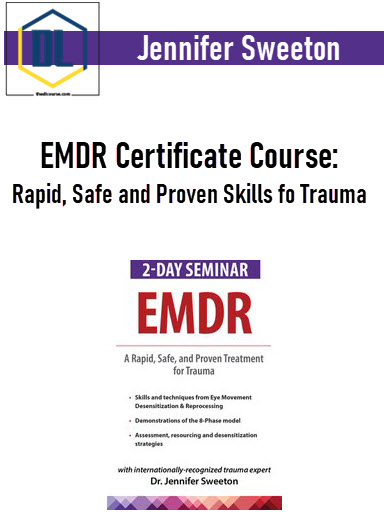
Jennifer Sweeton – EMDR Certificate Course: Rapid, Safe and Proven Skills and Techniques for Your Trauma Treatment Toolbox
Original price was: $439.99.$57.00Current price is: $57.00.
Description
Jennifer Sweeton – EMDR Certificate Course: Rapid, Safe and Proven Skills and Techniques for Your Trauma Treatment Toolbox
Watch this 2-Day EMDR Certificate Course recording and discover how this powerful, evidence-based treatment has helped thousands of clients safely and rapidly process their traumas so they can reclaim their lives!
What You’ll Learn EMDR Certificate Course
- How EMDR can be used to overcome avoidance in clients
- How EMDR techniques can help clients resolve traumatic memories
- When and with which clients EMDR should be used
- How to emphasize safety during sessions
- How the 8-phase model is used in treatment
- Learn how EMDR can help clients who desperately need relief from trauma!
Objectives
- Establish the role of the autonomic nervous system in trauma symptomology.
- Articulate the clinical implications of the freeze response in trauma treatment.
- Characterize the potential neurobiological mechanisms of change in the empirically validated EMDR approach.
- Specify how EMDR techniques can build dual awareness in clients to treat the avoidance that makes trauma treatment challenging.
- Communicate the 8 Phases of the EMDR protocol.
- Determine which clients you should use EMDR with.
- Analyze resourcing strategies from EMDR that clinicians can use to help facilitate the processing of trauma.
- Characterize how EMDR techniques can be used to reinforce and activate positive neural networks.
- Communicate how EMDR can be modified to work with complex/developmental trauma to directly treat traumatic memories.
- Evaluate strategies that can help foster the critical connection between client and therapist in EDMR therapy.
- Articulate the research limitations and potential risks associated with EMDR.
- Establish the order of operations for attachment-based EMDR treatment to resolve relational trauma.
Rapid, Safe and Proven Skills and Techniques for Your Trauma Treatment Toolbox
Trauma and Neuroscience
- Key brain areas involved in trauma
- Polyvagal Theory, and types of freeze responses
- Trauma and insecure attachment
- The neuroscience of developmental trauma
- Clinical implications of the freeze response
How the EMDR Approach Works
- The neuroscience of exposure therapy and cognitive therapy
- The neuroscience of relaxation exercises
- EMDR and other “transformative therapies”
- Why EMDR works so well from a brain perspective
Trauma Symptoms and Assessment Tools
- Traumatic memories and intrusive thoughts
- Phobias and anxiety: Insula hyperactivation
- Emotional hijackings and implicit memory
- Avoidance cluster of symptoms
- Why treating avoidance in trauma is critical
- DSM-5® symptoms in a nutshell
- Connecting to a diagnosis
Overcome Avoidance with EMDR
- Dual awareness
- What you are thinking about is the network you’re in
- Activate networks for change
- Neurons that fire together, wire together (Hebbb’s Rule)
- EMDR as neuroentrainment
- Demonstrations and experiential exercises
- Single event trauma
- Anxiety disorders involving imaginal exposure
EMDR Trauma Treatment: The Original 8-Phase Model
- Client history and treatment planning
- How to resource: Create as safe space
- Assessment: Choose a target, SUDS, connect with the image/emotions/thought
- Desensitization: Tactile vs. auditory vs. eye movement
- How to use touchpoints, Theratapper, CDs
- Positive Cognition Installation: Likert scale 1-7
- Body Scan: Locate tension and distress in the body
- Closure: Close the neural network and the 6-hour window
- Re-evaluation
Demonstration of Original 8-Phase Model
- Presenter demonstration
- Attendee dyad practice of the 8-phase model
EMDR Techniques to Resolve Traumatic Memories
- Modifications for Complex/Developmental Trauma
- Do not use standard protocol – Rationale for modifications
- Resourcing strategies
- Techniques to reinforce and activate positive neural networks
- Relevance of Polyvagal Theory, early trauma, and EMDR
- Sensory motor modifications and somatic approaches
- How to build Dual Awareness
- EMDR techniques to bring traumatic memories from the limbic system into the prefrontal cortex
Attachment-Based EMDR: Strategies to Treat Relational Trauma
- Strategies to foster the critical connection between client and therapist
- Mirror neuron activation
- How to emphasize safety during sessions
- Guidance on order of operations
Research Limitations and Potential Risks
Readmore about: Jennifer Sweeton
Delivery Policy
When will I receive my course?
You will receive a link to download your course immediately or within 1 to 21 days. It depends on the product you buy, so please read the short description of the product carefully before making a purchase.
How is my course delivered?
We share courses through Google Drive, so once your order is complete, you'll receive an invitation to view the course in your email.
To avoid any delay in delivery, please provide a Google mail and enter your email address correctly in the Checkout Page.
In case you submit a wrong email address, please contact us to resend the course to the correct email.
How do I check status of my order?
Please log in to TheDLCourse account then go to Order Page. You will find all your orders includes number, date, status and total price.
If the status is Processing: Your course is being uploaded. Please be patient and wait for us to complete your order. If your order has multiple courses and one of them has not been updated with the download link, the status of the order is also Processing.
If the status is Completed: Your course is ready for immediate download. Click "VIEW" to view details and download the course.
Where can I find my course?
Once your order is complete, a link to download the course will automatically be sent to your email.
You can also get the download link by logging into your TheDLCourse account then going to Downloads Page.
Related products
-51%

Original price was: $59.00.$29.00Current price is: $29.00.
-74%

Original price was: $99.00.$26.00Current price is: $26.00.
-62%

Original price was: $34.00.$13.00Current price is: $13.00.
-83%
Original price was: $199.00.$33.00Current price is: $33.00.
-60%
Original price was: $199.00.$79.00Current price is: $79.00.
-70%

Original price was: $199.00.$59.00Current price is: $59.00.
-58%

Original price was: $149.00.$62.00Current price is: $62.00.
-82%

Original price was: $119.99.$21.00Current price is: $21.00.