-
×
 Ross Jeffries – LA99 Speed Seduction
1 × $17.00
Ross Jeffries – LA99 Speed Seduction
1 × $17.00 -
×
 Tom Torero, Jon Matrix & Yad – Daygame.com: Date Against The Machine
1 × $10.00
Tom Torero, Jon Matrix & Yad – Daygame.com: Date Against The Machine
1 × $10.00 -
×
 Brian & Kam – Trading with Auction Market Theory and Volume Profiles
1 × $10.00
Brian & Kam – Trading with Auction Market Theory and Volume Profiles
1 × $10.00 -
×
 Alek Sheffield – The Six-figure Storefront
1 × $9.00
Alek Sheffield – The Six-figure Storefront
1 × $9.00 -
×
 Complete 32+ Hour Video Training Course 2008
1 × $25.00
Complete 32+ Hour Video Training Course 2008
1 × $25.00


-73%
Buy With Coupon: DLC25 (-25%)
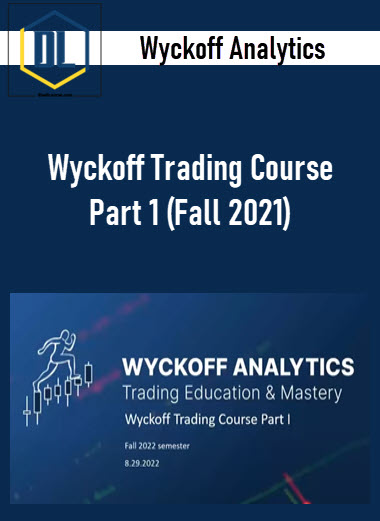
Wyckoff Analytics – Wyckoff Trading Course Part 1 (fall 2021)
Original price was: $998.00.$267.00Current price is: $267.00.
Description
Wyckoff Analytics – Wyckoff Trading Course Part 1 (fall 2021)
Wyckoff Trading Course Part 1 (fall 2021) Curriculum
Sessions 1-5 :
Marketstructural analysis. In this segment, you will learn to:
- Identify the all-important Change of Character in the price and volume of the market or of an individual security, allowing you to anticipate when it will move from a trending to a non-trending environment, and vice versa
- Understand the current price structural environment and its implications for trading at any given time
- Recognize key Wyckoff Events, such as buying and selling climaxes, springs, upthrusts, signs of strength or weakness, last points of support or supply, and more
- Distinguish Wyckoff Phases, which signify predictable developments in all trading ranges (and in all time frames), and allow you to spot when a new trend is about to emerge, so that you can place trades accordingly
Sessions 6-10 :
Supply and demand. In this course component, you can learn to “read the market” on any chart through:
- Volume and price analysis, a visual application of Wyckoff’s principle of contrasting effort (volume) vs result (price movement) to understand what the larger market participants are doing and what they probably intend. This segment will comprise:
- Bar-by-bar as well as swing-by-swing analysis of price and volume
- Analysis of volume patterns in different Wyckoff Phases
- Using historical analogues to compare recent price bar spread and volume with previous events, which can provide additional clues about the direction and character of future price movement
Sessions 11-12
Relative and comparative analysis. Another foundation of the Wyckoff Method involves comparing the performance of a stock, ETF or another security with that of the overall market or another instrument, helping you identify trade candidates that are likely to outperform both their peers and the overall market. Elements of this segment include:
- Relative and Comparative Analysis as an institutional signature of accumulation or distribution
- Fdentifying “Sweet spots” of outperformance as a predictor of future price behavior
- Filtering and scanning for relative outperformance characteristics
Session 15 Q&A session
Trade Management. Clear recognition and best practices regarding entry and exit points, stop-loss placement and movement, and proper scaling in and out of positions
Readmore about: Wyckoff Analytics
Delivery Policy
When will I receive my course?
You will receive a link to download your course immediately or within 1 to 21 days. It depends on the product you buy, so please read the short description of the product carefully before making a purchase.
How is my course delivered?
We share courses through Google Drive, so once your order is complete, you'll receive an invitation to view the course in your email.
To avoid any delay in delivery, please provide a Google mail and enter your email address correctly in the Checkout Page.
In case you submit a wrong email address, please contact us to resend the course to the correct email.
How do I check status of my order?
Please log in to TheDLCourse account then go to Order Page. You will find all your orders includes number, date, status and total price.
If the status is Processing: Your course is being uploaded. Please be patient and wait for us to complete your order. If your order has multiple courses and one of them has not been updated with the download link, the status of the order is also Processing.
If the status is Completed: Your course is ready for immediate download. Click "VIEW" to view details and download the course.
Where can I find my course?
Once your order is complete, a link to download the course will automatically be sent to your email.
You can also get the download link by logging into your TheDLCourse account then going to Downloads Page.
Related products
-97%
Original price was: $274.99.$9.00Current price is: $9.00.
-40%
Original price was: $117.00.$70.00Current price is: $70.00.
-97%

Original price was: $2,995.00.$79.00Current price is: $79.00.
-99%
Original price was: $997.00.$10.00Current price is: $10.00.
-97%

Original price was: $300.00.$9.00Current price is: $9.00.
-97%

Original price was: $350.00.$9.00Current price is: $9.00.
-48%
Original price was: $21.00.$11.00Current price is: $11.00.
-95%

Original price was: $795.00.$39.00Current price is: $39.00.