-
×
 Pattern Piano and Keyboard 2011 Full Bundle
1 × $29.90
Pattern Piano and Keyboard 2011 Full Bundle
1 × $29.90 -
×
 Gregory lorenzo – The Luxury Look
1 × $59.00
Gregory lorenzo – The Luxury Look
1 × $59.00 -
×
 Qi Gong Training – Ultra Mi Zong Taoist Yoga
1 × $36.80
Qi Gong Training – Ultra Mi Zong Taoist Yoga
1 × $36.80 -
×
 The Modern Man – The Flow Audiobook
1 × $37.00
The Modern Man – The Flow Audiobook
1 × $37.00 -
×
 B The Trader – Trading Course
1 × $20.00
B The Trader – Trading Course
1 × $20.00 -
×
 Alek Sheffield – The Six-figure Storefront
1 × $9.00
Alek Sheffield – The Six-figure Storefront
1 × $9.00 -
×
 Rich Shy Girl – The Formula
1 × $9.00
Rich Shy Girl – The Formula
1 × $9.00 -
×
 Talmadge Harper – Human Lie Detector
1 × $15.00
Talmadge Harper – Human Lie Detector
1 × $15.00 -
×
 Tom Torero, Jon Matrix & Yad – Daygame.com: Date Against The Machine
1 × $10.00
Tom Torero, Jon Matrix & Yad – Daygame.com: Date Against The Machine
1 × $10.00 -
×
 Body By Rings
2 × $33.00
Body By Rings
2 × $33.00 -
×
 Justin Brooke – Growth Operator Blueprint
1 × $33.00
Justin Brooke – Growth Operator Blueprint
1 × $33.00 -
×
 Bob Burns – The Swan Speaks
1 × $17.00
Bob Burns – The Swan Speaks
1 × $17.00 -
×
 Alexey Molchanov – Foundational Breathwork
1 × $37.00
Alexey Molchanov – Foundational Breathwork
1 × $37.00 -
×
 Victor Casler – Personalized DeFi Crash Course
1 × $10.00
Victor Casler – Personalized DeFi Crash Course
1 × $10.00 -
×
 Jeff Glover – Break a Leg DVD or Blu Ray
1 × $14.00
Jeff Glover – Break a Leg DVD or Blu Ray
1 × $14.00 -
×
 George Hutton – Alpha Female
1 × $10.00
George Hutton – Alpha Female
1 × $10.00 -
×
 Jermain Linton – Create Unlimited $450 Credit Adwords Accounts and VCCs
1 × $50.00
Jermain Linton – Create Unlimited $450 Credit Adwords Accounts and VCCs
1 × $50.00 -
×
 Gemma Bonham-Carter – The Passive Project
1 × $9.00
Gemma Bonham-Carter – The Passive Project
1 × $9.00 -
×
 Liana Ling – Bullet Proof Meta (Facebook) Ads
1 × $9.00
Liana Ling – Bullet Proof Meta (Facebook) Ads
1 × $9.00 -
×
 Ross Jeffries – Ultimate Language Pattern Collection
1 × $37.00
Ross Jeffries – Ultimate Language Pattern Collection
1 × $37.00 -
×
 Taylor Jackson – Creating Profitable YouTube Videos
2 × $20.00
Taylor Jackson – Creating Profitable YouTube Videos
2 × $20.00 -
×
 Essentials of Elite Performance – S-Phase
1 × $131.00
Essentials of Elite Performance – S-Phase
1 × $131.00 -
×
 John Overdurf – Changing Perspectives through the Rhizome
1 × $45.00
John Overdurf – Changing Perspectives through the Rhizome
1 × $45.00 -
×
 Billy Gene – 5 Day AI Crash Course for Marketers
1 × $35.00
Billy Gene – 5 Day AI Crash Course for Marketers
1 × $35.00 -
×
 Andrew Mioch – Lasting System
1 × $273.00
Andrew Mioch – Lasting System
1 × $273.00 -
×
 Zac Hansen – The Productized Community
1 × $29.00
Zac Hansen – The Productized Community
1 × $29.00 -
×
 Garin Bader – Core Force Energy System
1 × $10.00
Garin Bader – Core Force Energy System
1 × $10.00


-65%
Buy With Coupon: DLC25 (-25%)
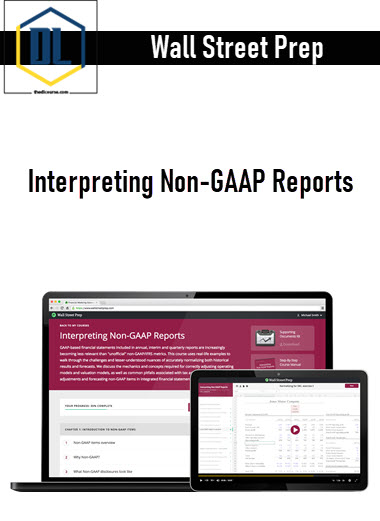
Wall Street Prep – Interpreting Non-GAAP Reports
Original price was: $79.00.$28.00Current price is: $28.00.
Description
Wall Street Prep – Interpreting Non-GAAP Reports
Learn how to interpret non-GAAP disclosures and model their impact on historical results, forecasts and valuation. This course on interpreting non-GAAP reports is designed for investment bankers as well as equity research and credit analysts.
Why you should take this course?
- GAAP-based financial statements are increasingly becoming less relevant than “unofficial” non-GAAP/IFRS metrics.
- Here, we walk through the challenges and lesser-understood nuances of accurately normalizing historical results and forecasts.
- We discuss the mechanics and concepts required to correctly adjust operating and valuation models as well as common pitfalls associated with tax adjustments, share count adjustments and forecasting non-GAAP items in financial models.
What will you learn in Interpreting Non-GAAP Reports?
Chapter 1: Introduction to non-GAAP items
1. Non-GAAP course welcome
2. Course Downloads
3. Non-GAAP items overview
4. Why Non-GAAP?
5. What Non-GAAP disclosures look like
6. Why firms are motivated to show Non-GAAP
7. Prevalence of non-GAAP disclosures
8. Regulatory oversight of non-GAAP
9. Two broad types of non-GAAP items
Chapter 2: Nonrecurring items
10. Nonrecurring items under GAAP
11. Unusual or infrequent items under GAAP
12. Non-GAAP nonrecurring items
13. Normalizing GAAP financials
14. Normalizing GAAP financials, II
15. Non-GAAP impact on valuation
16. Too many non-recurring items?
17. Nonrecurring items disclosures in practice
18. Income statement classification
Chapter 3: Noncash items — Stock based compensation
19. Introduction to non-cash items
20. Argument for & against adding back SBC
21. Stock based compensation (SBC) review
22. Normalizing for SBC, exercise I
23. SBC disclosures in practice
24. Normalizing for SBC, exercise II
25. Amortization of capitalized SBC
Chapter 4: Noncash items — Intangible asset amortization
26. Noncash items overview
27. Acquired intangibles exercise
Chapter 5: Historical EBITDA
28. Introduction to EBITDA
29. EBITDA and Adjusted EBITDA exercises
30. Determining Athena’s historical EBITDA
Chapter 6: Forecasting EBITDA
31. Forecasting EBITDA
32. ATHN bottom up EBITDA, exercise I
33. The problem with the bottom up approach
34. ATHN bottom up EBITDA exercise II
35. ATHN EBITDA solution walk through
36. Top down EBITDA forecasting
Chapter 7: Other non-GAAP topics
37. Non-IFRS disclosures in practice
38. Non-GAAP issues in a 3-statement model
39. Non-GAAP diluted share count
40. Non-GAAP Items Conclusion
Who is this course for?
This course is designed for professionals and those pursing a career in the following finance careers:
- Investment Banking
- Buy-Side Equity Research
- Sell-Side Equity Research
- Private Equity
- Credit Research
- FP&A and Corporate Finance
Prerequisites
The program assumes a basic introductory knowledge of accounting (e.g. interaction of balance sheet, cash flow, and income statement) and proficiency in Excel. Students with no prior background in Accounting should enroll in the Accounting Crash Course. Students with limited experience using Excel should enroll in the Excel Crash Course.
Readmore about: Wall Street Prep
Delivery Policy
When will I receive my course?
You will receive a link to download your course immediately or within 1 to 21 days. It depends on the product you buy, so please read the short description of the product carefully before making a purchase.
How is my course delivered?
We share courses through Google Drive, so once your order is complete, you'll receive an invitation to view the course in your email.
To avoid any delay in delivery, please provide a Google mail and enter your email address correctly in the Checkout Page.
In case you submit a wrong email address, please contact us to resend the course to the correct email.
How do I check status of my order?
Please log in to TheDLCourse account then go to Order Page. You will find all your orders includes number, date, status and total price.
If the status is Processing: Your course is being uploaded. Please be patient and wait for us to complete your order. If your order has multiple courses and one of them has not been updated with the download link, the status of the order is also Processing.
If the status is Completed: Your course is ready for immediate download. Click "VIEW" to view details and download the course.
Where can I find my course?
Once your order is complete, a link to download the course will automatically be sent to your email.
You can also get the download link by logging into your TheDLCourse account then going to Downloads Page.
Related products
-41%

Original price was: $22.00.$13.00Current price is: $13.00.
-84%

Original price was: $420.00.$67.00Current price is: $67.00.
-33%

Original price was: $29.90.$20.00Current price is: $20.00.


-86%

Original price was: $399.00.$57.00Current price is: $57.00.
-60%

Original price was: $50.00.$20.00Current price is: $20.00.
-73%

Original price was: $99.90.$27.00Current price is: $27.00.